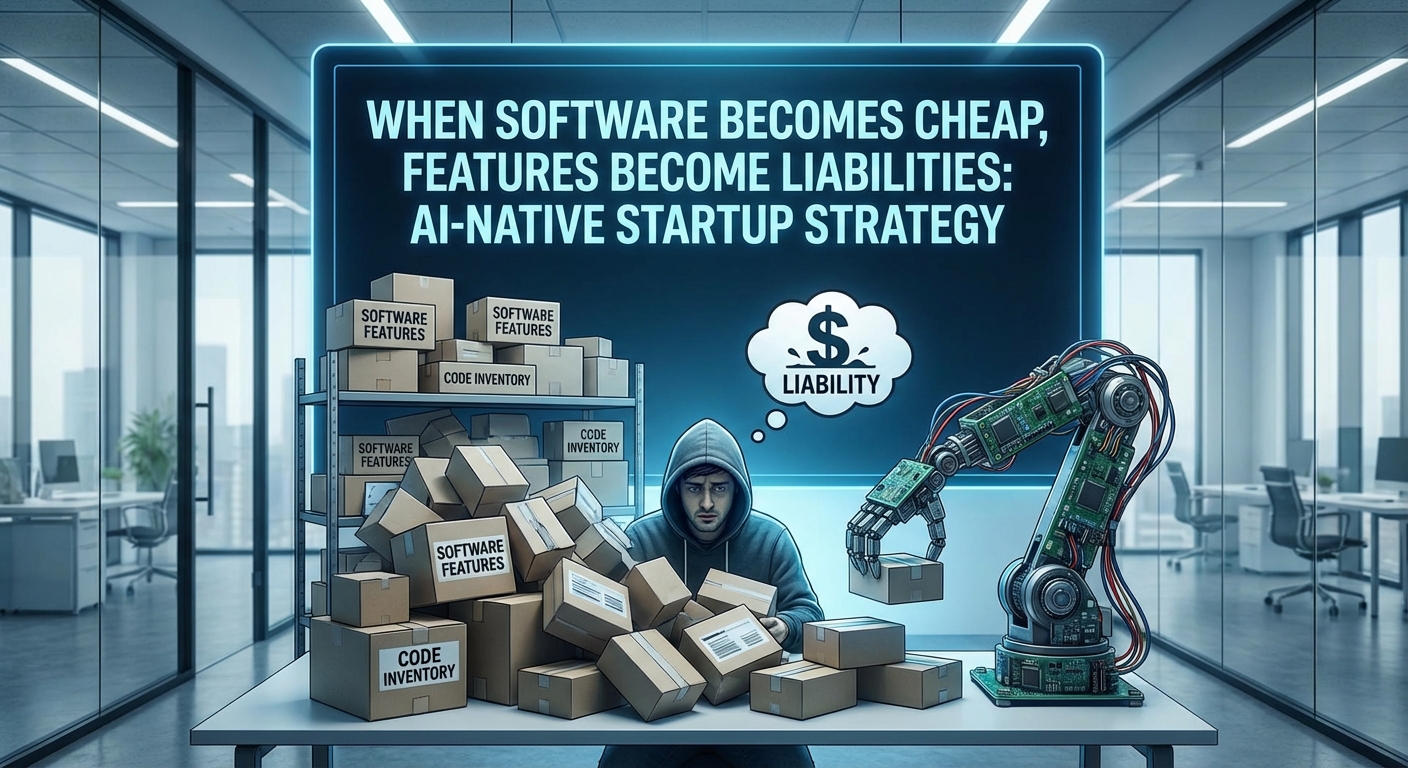
AI is changing the economics of building software. The old assumption—that shipping more code automatically creates a durable asset—is getting less true every year.
This post breaks down a core idea: as AI makes software cheaper and faster to build, “software inventory” (features/code) can shift from asset to liability—and what that means for startup strategy: moats, pricing, and what to build (or avoid).
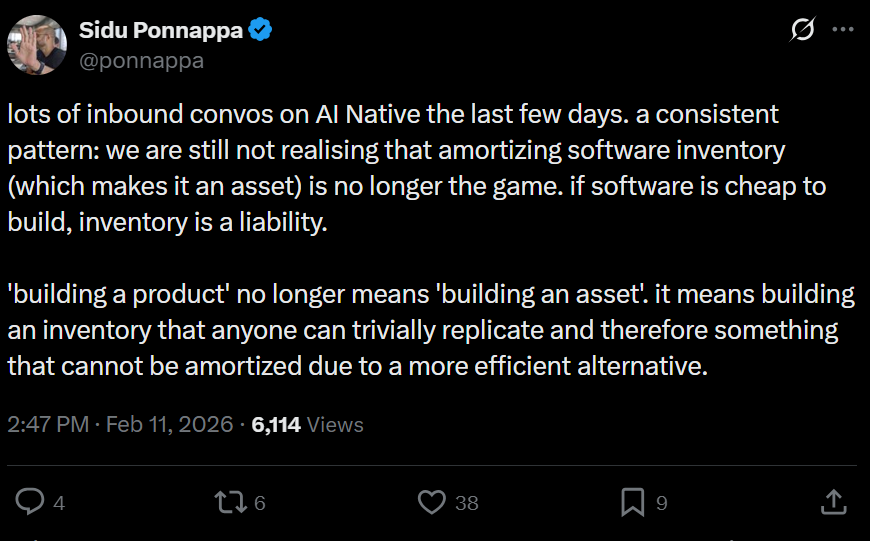
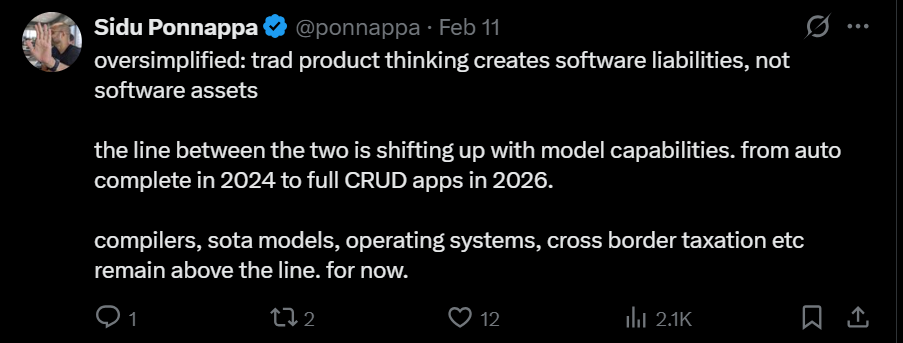
A recent tweet from Sidu Ponnappa (see above) argued:
- Historically, building software was expensive.
- Because it was expensive, the software you built behaved like an asset: you could amortize the cost over time and across customers.
- As AI makes software cheap to produce, the same inventory becomes easy to replicate, so it stops being defensible.
- Meanwhile you still pay the ongoing cost: maintenance, support, complexity, technical debt.
- Therefore, in many cases, software inventory becomes a liability, not an asset.
The tweet also claims the boundary is moving fast. What was “hard” last year becomes “easy” soon:
- 2024: AI autocompletes code
- 2026: AI can generate full CRUD apps (common internal tools and standard SaaS surfaces)
Some things remain “above the line” for now—harder to replicate due to depth or complexity: compilers, frontier models, operating systems, cross-border taxation logic, etc.
The key takeaway:
Traditional product thinking (“ship features; build big codebases”) increasingly creates software liabilities, not durable software assets.
Why “Software Inventory” Can Turn Into a Liability
In traditional product development:
- You invest heavily to build features (inventory).
- You sell those features to many customers.
- You recoup the cost over time (amortization).
- Competitors can’t copy quickly, so the inventory stays differentiated.
In an AI-native environment, the same playbook breaks:
- If competitors can reproduce your core features in weeks, you can’t count on amortization.
- Yet every feature still adds long-term costs:
- maintenance
- regression risk
- customer support
- documentation burden
- technical debt
So your “asset” can flip:
- Easy to copy + expensive to maintain = liability.
What This Means for Startup Strategy
When code becomes cheap, startups win less by “building more” and more by building advantages that compound.
1) Moats: Shift from “Code Moat” to “Advantage Moat”
If a capable team can replicate your product quickly using AI, then “we built it first” is not a moat.
Moats that tend to hold up better:
Distribution
- Owned audience
- Partnerships
- SEO dominance
- Strong sales motion
- Embedding into a channel where you become the default
Workflow embedding & switching costs
- You become the place work happens
- Deep role/permission models, approvals, audit trails
- Configuration embedded into the customer’s operations
- Integration into the customer’s existing systems
Data advantage (sometimes)
Not “we have a database,” but:
- data you uniquely generate
- feedback loops that continuously improve results
- data gated by relationships/contracts or physical operations
Operational moat
Many AI products are actually ops companies with software:
- human-in-the-loop quality control
- escalation handling
- edge-case resolution
- exceptional support and turnaround time
Trust & risk moat
- security and compliance posture (SOC2/ISO/HIPAA where relevant)
- auditability and governance
- uptime and SLAs
- procurement readiness
Cost moat
- model routing
- caching
- using smaller models where possible
- evaluation-driven optimization
Weaker moats:
- “we have a lot of features”
- “we wrapped a foundation model”
- “we have prompts”
- “we integrated model X”
- generic CRUD + chatbot without distribution, trust, or workflow lock-in
A useful test:
If a competitor can match your core in 2–6 weeks, your moat is not code.
2) Pricing: Align With Outcomes, Not Software Complexity
When the cost to build drops, customers expect pricing to follow value delivered, not engineering effort.
Pricing approaches that fit AI-native products:
Outcome-based pricing
Examples:
- per ticket resolved
- per claim processed
- per invoice reconciled
- per lead qualified
Usage-based pricing (with a value-aligned unit)
Examples:
- per document processed
- per workflow run
- per 1,000 actions
Governance / risk-based packaging
Higher tiers can include:
- human review
- audit logs
- custom policies
- compliance controls
- SLAs and priority support
Managed service pricing
Often the winning product is software + operations.
Watchouts:
- Seat-based pricing can clash with AI’s promise (reducing headcount).
- If inference cost scales with usage, protect margins (routing/caching/efficiency).
- Commoditization can drive price pressure—differentiate with trust, workflow depth, distribution, or proprietary access.
3) What to Build (and What to Avoid)
The strategic shift is to build systems that compound and avoid piling on features that create maintenance without durable advantage.
Build: A wedge into a painful workflow
Aim for:
- end-to-end resolution of a specific job-to-be-done
- clear ownership of a workflow stage
- a tight loop from use → data → improved results
Example framing:
- ✅ “We reconcile vendor invoices end-to-end.”
- ❌ “We have an AI invoice parser.”
Build: Opinionated workflow products
Not a generic assistant—something with:
- states
- roles/permissions
- approvals
- escalation paths
- audit trails
Build: Integration depth
Integrate into systems the customer already uses:
- ERP/CRM/HRIS
- ticketing and chat
- identity/auth
- data warehouses
Build: Reliability infrastructure as product
Reliability becomes a moat:
- evaluation suites
- monitoring
- guardrails
- versioning
- reproducibility
- human review workflows
Build: Data flywheels you can earn
You want data that is:
- generated as a byproduct of doing real work
- hard for others to access without being embedded in the workflow
Avoid (or be cautious with): Feature inventory arms races
Be careful about:
- generic CRUD apps with thin differentiation
- “dashboard + chat” clones
- pure wrappers around a model (no proprietary edge)
- building broad platforms too early
- customization that turns you into a bespoke dev shop (unless you price for it)
The core risk:
Easy-to-copy features + long-term maintenance = liabilities.
A Practical “Asset vs Liability” Test for Roadmaps
Before building something, ask:
- Can a competitor replicate this quickly with AI?
- If yes, do we still win via distribution, workflow embedding, data, trust, cost, or ops?
- Does this create ongoing maintenance burden?
- Does this create a compounding advantage?
If it’s easy to copy and adds maintenance, don’t build it unless it’s essential to your wedge.
GTM Reality: Go-to-Market Matters More as Build Costs Fall
As software gets cheaper to create, go-to-market becomes relatively more important.
- Enterprise: procurement readiness, security posture, references, ROI proof, pilots that convert
- SMB/self-serve: onboarding, templated value, channel dominance, internal virality
Example Positioning Shifts (From Feature → Outcome)
Instead of:
“AI customer support chatbot”
Move toward:
“We resolve 70% of Tier-1 tickets with auditability, policy controls, and CRM-native workflows; priced per resolution.”
Instead of:
“AI CRM”
Move toward:
“We generate follow-ups, update pipeline automatically, enforce compliance in regulated sales, and integrate deeply with existing systems.”
Final Takeaway
AI pushes software toward commoditization—especially standard product surfaces and CRUD-style apps.
So the goal isn’t to build more software inventory.
The goal is to build compounding advantages:
- distribution
- workflow lock-in
- proprietary data loops
- trust and governance
- operational excellence
- cost and reliability advantages
Code is increasingly disposable. The business you build around it shouldn’t be.